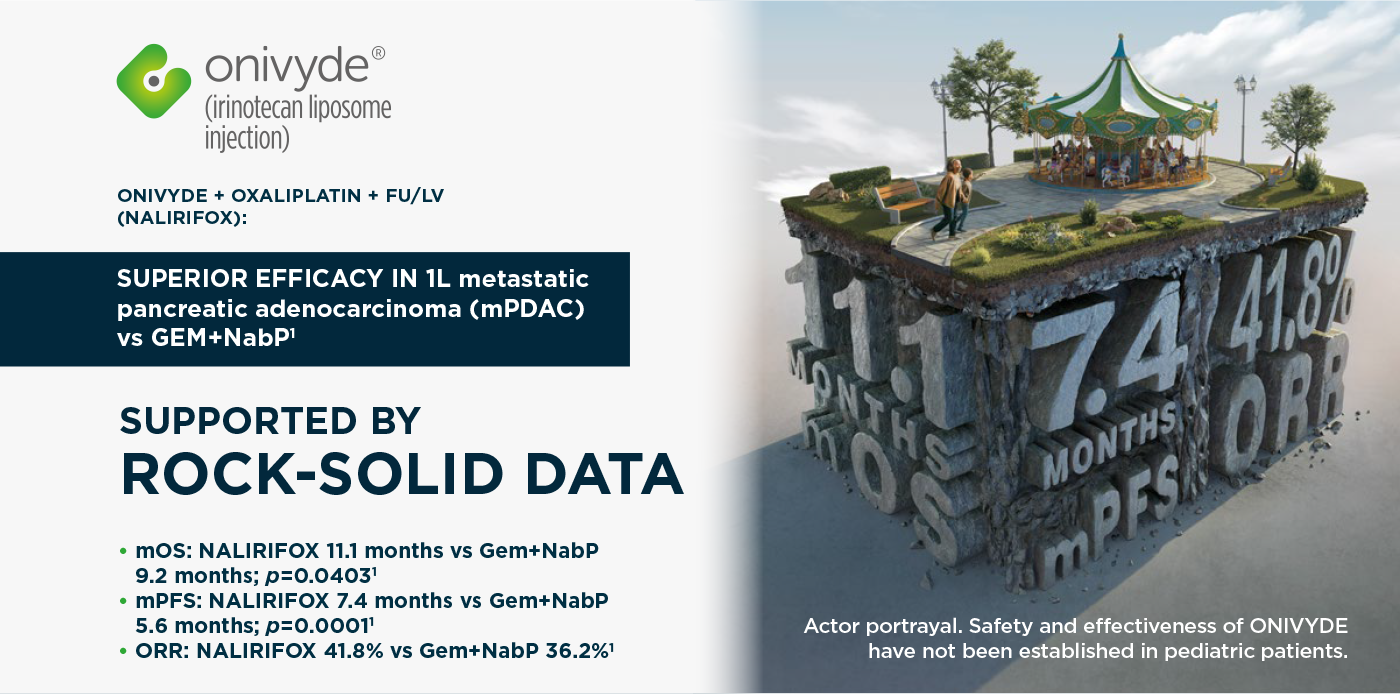
ONIVYDE® (as part of the NALIRIFOX regimen) is now FDA-approved for the 1L treatment of mPDAC1 |
|
|
For more information about how this may benefit appropriate patients with mPDAC, contact us today.
Please see below for Indications and Important Safety Information including BOXED WARNING.
NAPOLI 3: a randomized, open-label, phase 3 trial of NALIRIFOX (N=383) vs gemcitabine + nab-paclitaxel (Gem+NabP) (N=387) in patients with metastatic pancreatic adenocarcinoma who had not received chemotherapy in the metastatic setting. Primary endpoint: overall survival (OS); secondary endpoints: progression-free survival (PFS) and objective response rate (ORR):1,2
|
• |
mOS: NALIRIFOX 11.1 months (95% CI: 10.0, 12.1) vs Gem+NabP 9.2 months (95% CI: 8.3, 10.6); HR (95% CI): 0.84 (0.71, 0.99); p=0.0403 |
|
• |
mPFS: NALIRIFOX 7.4 months (95% CI: 6.0, 7.7) vs Gem+NabP 5.6 months (95% CI: 5.3, 5.8); HR (95% CI): 0.70 (0.59, 0.85); p=0.0001 |
|
• |
ORR: NALIRIFOX 41.8% (95% CI: 36.8, 46.9) vs Gem+NabP 36.2% (95% CI: 31.4, 41.2) |
1L, first line; CI, confidence interval; FU, fluorouracil; FDA, Food and Drug Administration; Gem, gemcitabine; LV, leucovorin; m, median; NabP, nab-paclitaxel. | | |
INDICATIONS
ONIVYDE® (irinotecan liposome injection) is indicated:
|
• |
in combination with oxaliplatin, fluorouracil, and leucovorin, for the first-line treatment of adult patients with metastatic pancreatic adenocarcinoma. |
|
• |
in combination with fluorouracil and leucovorin, for the treatment of adult patients with metastatic pancreatic adenocarcinoma after disease progression following gemcitabine-based therapy. |
Limitations of Use: ONIVYDE is not indicated as a single agent for the treatment of patients with metastatic pancreatic adenocarcinoma.
IMPORTANT SAFETY INFORMATION
|
WARNING: SEVERE NEUTROPENIA AND SEVERE DIARRHEA
Neutropenia
|
• |
Severe and life-threatening neutropenia, including fatal neutropenic sepsis and fatal neutropenic fever, has occurred in patients receiving ONIVYDE in combination with oxaliplatin, fluorouracil, and leucovorin and in combination with fluorouracil and leucovorin. Withhold ONIVYDE for absolute neutrophil count below 1500/mm3 or neutropenic fever. Monitor blood cell counts periodically during treatment. |
Diarrhea
|
• |
Severe and life-threatening diarrhea has occurred in patients receiving ONIVYDE in combination with oxaliplatin, fluorouracil, and leucovorin and in combination with fluorouracil and leucovorin. Do not administer ONIVYDE to patients with bowel obstruction. Withhold ONIVYDE for diarrhea of Grade 2-4 severity. Administer loperamide for late diarrhea of any severity. Administer atropine, if not contraindicated, for early diarrhea of any severity. | | | | |
CONTRAINDICATIONS
|
• |
ONIVYDE is contraindicated in patients who have experienced a severe hypersensitivity reaction or anaphylaxis to ONIVYDE or irinotecan HCl. |
WARNINGS AND PRECAUTIONS
|
• |
Severe Neutropenia:
See Boxed WARNING. In NAPOLI 3, Grade 3 and 4 neutropenia occurred in 26% of patients receiving ONIVYDE in combination with oxaliplatin, fluorouracil, and leucovorin (NALIRIFOX) and fatal neutropenic fever in 0.3% of patients. In NAPOLI 3, the incidence of Grade 3 or 4 neutropenia was similar among Asian patients [6 of 20 (30%)] compared to White patients [76 of 289 (26%)]. Neutropenic fever/neutropenic sepsis was reported in 5% of Asian patients (1 of 20) compared to 2.3% of White patients (7 of 306). In NAPOLI-1, Grade 3 and 4 neutropenia occurred in 20% of patients receiving ONIVYDE in combination with fluorouracil and leucovorin (ONIVYDE/ FU/LV). Neutropenic sepsis occurred in 3% and fatal neutropenic sepsis in 0.8%. In NAPOLI-1, the incidence of Grade 3 or 4 neutropenia was
higher among Asian patients [18 of 33 (55%)] compared to White patients [13 of 73 (18%)]. Neutropenic fever/neutropenic sepsis was reported in 6% of Asian patients compared to 1% of White patients.
Monitor complete blood cell counts on Days 1 and 8 of every cycle and more frequently if clinically indicated. Withhold ONIVYDE if the absolute neutrophil count (ANC) is below 1500/mm3 or if neutropenic fever occurs. Resume ONIVYDE when the ANC is 1500/mm3 or above. Reduce ONIVYDE dose for Grade 3-4 neutropenia or neutropenic fever following recovery in subsequent cycles. |
|
• |
Severe Diarrhea: See Boxed WARNING. In NAPOLI 3, Grade 3 and 4 diarrhea (early-onset [within 24 hours of chemotherapy] and late-onset [more than 24 hours following chemotherapy]) occurred in 20% receiving NALIRIFOX. In NAPOLI-1, Grade 3 or 4 diarrhea occurred in 13% receiving ONIVYDE/FU/LV. The incidence of Grade 3 or 4 late-onset diarrhea was 9% in patients receiving ONIVYDE/FU/LV. The incidence of Grade 3 or 4 early-onset diarrhea was 3% in patients receiving ONIVYDE/FU/LV.
To reduce the risk of severe diarrhea, patients should stop lactose-containing products, eat a low-fat diet, and maintain hydration during treatment with ONIVYDE. Withhold ONIVYDE for Grade 2-4 diarrhea. Local institutional guidelines should be followed for the treatment of diarrhea that does not improve within 48 hours and may include the addition of diphenoxylate hydrochloride plus atropine sulfate or octreotide. Following recovery to Grade 1 diarrhea, resume ONIVYDE at a reduced dose. |
|
• |
Interstitial Lung Disease (ILD): Irinotecan HCl can cause severe and fatal ILD. Patients with risk factors should be closely monitored for respiratory symptoms before and during ONIVYDE therapy. Withhold ONIVYDE in patients with new or progressive dyspnea, cough, and fever, pending diagnostic evaluation. Discontinue ONIVYDE in patients with a confirmed diagnosis of ILD. |
|
• |
Severe Hypersensitivity Reaction: Irinotecan, including ONIVYDE, can cause severe hypersensitivity reactions, including anaphylactic reactions. Permanently discontinue ONIVYDE in patients who experience a severe hypersensitivity reaction. |
|
• |
Embryo-Fetal Toxicity: ONIVYDE can cause fetal harm when administered to a pregnant woman. Advise pregnant women of the potential risk to a fetus. Advise females of reproductive potential to use effective contraception during and for 7 months after the last dose of ONIVYDE treatment. |
ADVERSE REACTIONS FOR NALIRIFOX
|
• |
The most common adverse reactions (≥20%) of NALIRIFOX were diarrhea (72%), fatigue (62%), nausea (59%), vomiting (40%), decreased appetite (37%), abdominal pain (35%), mucosal inflammation (28%), constipation (25%), and weight decreased (22%). |
|
• |
Permanent discontinuation of ONIVYDE due to an adverse reaction occurred in 17% of patients. Adverse reactions that resulted in permanent discontinuation of ONIVYDE in ≥1% of patients included neutropenia, thrombocytopenia, diarrhea, fatigue, infections, and cerebrovascular accident. |
|
• |
Dosage reduction of ONIVYDE due to an adverse reaction occurred in 52% of patients. Adverse reactions that required dosage reduction in ≥1% of patients included anemia, decreased appetite, diarrhea, fatigue, febrile neutropenia, hypokalemia, liver function test abnormalities, nausea, mucosal inflammation, neutropenia, peripheral neuropathy, vomiting, thrombocytopenia, and weight decreased. |
|
• |
Dosage interruptions of ONIVYDE due to an adverse reaction occurred in 1.9% of patients. Adverse reactions which required dosage interruption in ≥0.5% of patients included hypersensitivity and infusion-related reaction. |
|
• |
The most common laboratory abnormalities (≥10% Grade 3 or 4) were decreased neutrophils (26%), decreased potassium (22%), decreased lymphocytes (11%), and decreased hemoglobin (10%). |
ADVERSE REACTIONS FOR ONIVYDE/FU/LV
|
• |
The most common adverse reactions (≥20%) were diarrhea (59%), fatigue/asthenia (56%), vomiting (52%), nausea (51%), decreased appetite (44%), stomatitis (32%), and pyrexia (23%). |
|
• |
Adverse reactions led to permanent discontinuation of ONIVYDE in 11% of patients receiving ONIVYDE/FU/LV; the most frequent adverse reactions resulting in discontinuation of ONIVYDE were diarrhea, vomiting, and sepsis. |
|
• |
Dose reductions of ONIVYDE for adverse reactions occurred in 33% of patients receiving ONIVYDE/FU/LV; the most frequent adverse reactions requiring dose reductions were neutropenia, diarrhea, nausea, and anemia. |
|
• |
ONIVYDE was withheld or delayed for adverse reactions in 62% of patients receiving ONIVYDE/FU/LV; the most frequent adverse reactions requiring interruption or delays were neutropenia, diarrhea, fatigue, vomiting, and thrombocytopenia. |
|
• |
The most common severe laboratory abnormalities (≥10% Grade 3 or 4) were lymphopenia and neutropenia. |
Postmarketing Experience: Immune system disorders: Hypersensitivity (including anaphylactic reaction and angioedema)
DRUG INTERACTIONS
|
• |
Avoid the use of strong CYP3A4 inducers, if possible, and substitute non-enzyme inducing therapies ≥2 weeks prior to initiation of ONIVYDE. |
|
• |
Avoid the use of strong CYP3A4 or UGT1A1 inhibitors, if possible, and discontinue strong CYP3A4 inhibitors ≥1 week prior to starting therapy. |
USE IN SPECIFIC POPULATIONS
|
• |
Pregnancy and Reproductive Potential: See WARNINGS & PRECAUTIONS. Advise males with female partners of reproductive potential to use condoms during and for 4 months after the last dose of ONIVYDE treatment. |
|
• |
Lactation: Advise nursing women not to breastfeed during and for 1 month after the last dose of ONIVYDE treatment |
To report SUSPECTED ADVERSE REACTIONS, contact Ipsen Biopharmaceuticals, Inc. at 1‑855‑463‑5127 or FDA at 1-800-FDA-1088 or www.fda.gov/medwatch.
Please click here for full Prescribing Information including BOXED WARNING for ONIVYDE. | | |
References: 1. ONIVYDE® (irinotecan liposome injection) [package insert]. Cambridge, MA. Ipsen Biopharmaceuticals, Inc.; 2024. 2. Wainberg ZA, Melisi D, Macarulla T, et al. NALIRIFOX versus nab-paclitaxel and gemcitabine in treatment-naive patients with metastatic pancreatic ductal adenocarcinoma (NAPOLI 3): a randomised, open-label, phase 3 trial. Lancet. 2023;402(10409):1272-1281. | | |
You are receiving this advertisement on behalf of Ipsen Biopharmaceuticals, Inc.,
One Main Street, 7th Floor, Cambridge, MA 02142.
| | |
ONIVYDE is a registered trademark of Ipsen Biopharm Ltd. All other trademarks and registered trademarks are the property of their respective owners.
©2024 Ipsen Biopharmaceuticals, Inc. All rights reserved. ONV‑US‑004791 March 2024 | | | |